

Stephanie Hanna | Community Programs Manager
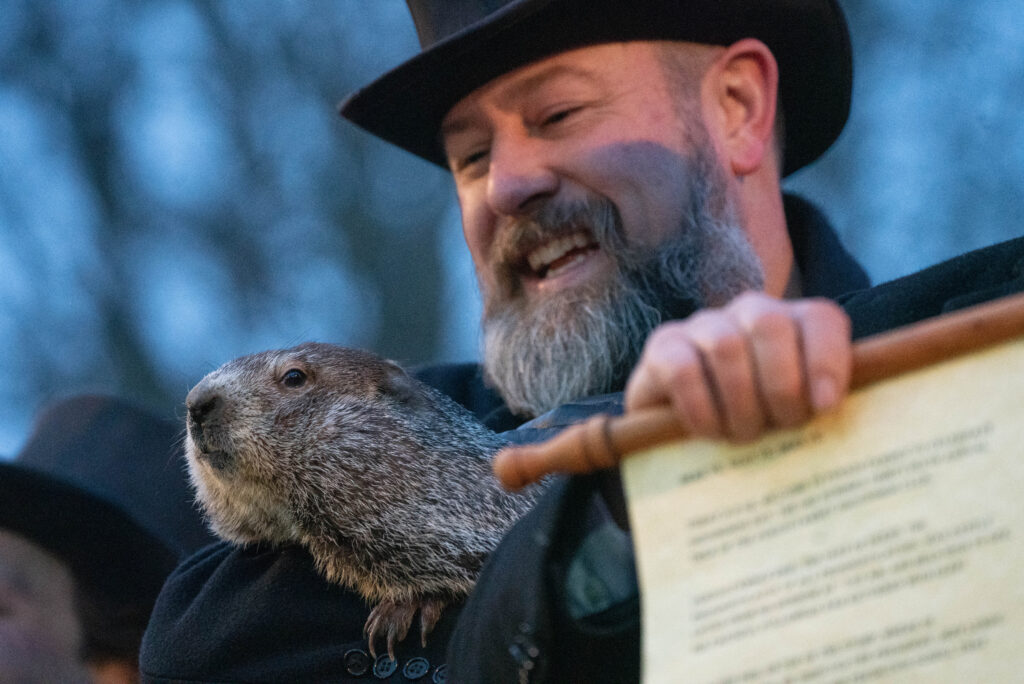
So what did Punxsutawney Phil predict on February 2? More winter or early spring? Either way, this rascally rodent only has a 35–39% accuracy. And why February 2? That’s the midpoint between the winter solstice and the spring equinox.
And why have a groundhog, also called a woodchuck, predicting the weather? This tradition is a folklore-based mid-winter custom rooted in German, Christian, and Pagan traditions. Punxsutawney Phil has been “predicting” since 1887.
What Exactly is Hibernation?
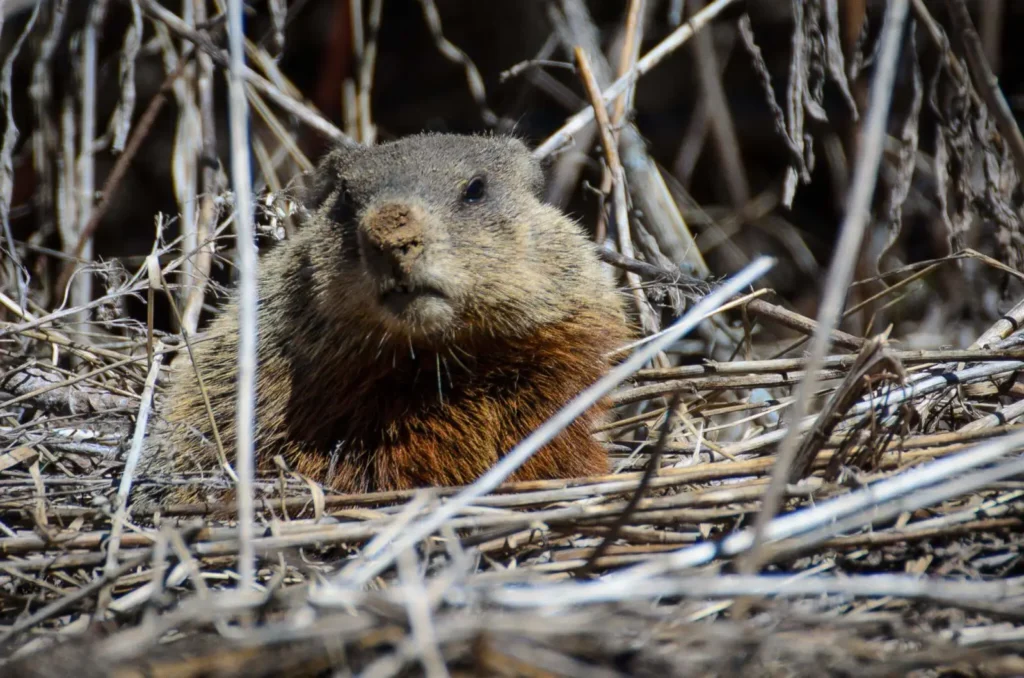
Woodchucks naturally wake up in early spring from hibernation to begin their mating season. Scientists do not quite know everything about it yet. According to Environmental Education for Kids (my favorite resource from the Wisconsin Department of Natural Resources), scientists have found a special substance in the blood of hibernating animals called Hibernating Inducement Trigger (HIT). As found in experiments, “If blood is taken from a hibernating ground squirrel in the winter and injected into an active ground squirrel in the spring, the active ground squirrel goes into hibernation.”
There are different kinds of hibernation. Woodchucks are true hibernators.
- Their heart rate slows dramatically, dropping from about 80 beats per minute when active to just 4–5 beats per minute during hibernation.
- Their body temperature drops sharply, falling from around 98°F to about 38°F while they hibernate.
- Growth of their incisors slow, because, while they hibernate, they aren’t gnawing on food to keep their teeth worn down.
- They hibernate underground in special chambers within their burrow systems. These hibernation spaces are below the frost line (about 2–6 feet deep) and are lined with dried grass.
- They wake up every few weeks to use a separate underground “toilet room.”
Why Phil is Probably a Male Woodchuck
It seems likely that Phil from Punxsutawney is a male groundhog, since males are the ones that briefly emerge from hibernation in early February to look for females and reestablish social bonds. They are not out to predict the weather for the rest of the winter season. Woodchucks’ bonding does seem appropriate at this time since the tradition of Valentine’s Day is also in February.
Males then return to their hibernation area, and both male and female emerge in time for breeding to happen from early March to late April. Litters of 2- 6 chucklings (babies are also called kits or pups) are born after about 32 days in April or May. Males leave the den when the chucklings are born, leaving the sow to take care of them for 6 weeks until they are weaned. Groundhogs are actually solitary animals, and the chucklings leave the den to find their own den at about 2 months old.
A Groundhog Day Movie Moment and a Nature Place Connection
Of course, since I am a film fan, I cannot discuss groundhogs or woodchucks and this time of the year without mentioning the film Groundhog Day. The main character, cynical meteorologist Phil Connors, is stuck in an endless time loop of self-centeredness. He repeats his Groundhog Day about 415 times (different sources online say different numbers, but he does repeat his day a lot) until he realizes that love and connection to others around him are the key to life.
Reminds me of what we do at The Nature Place: connect people and nature for the benefit of both. Just like real woodchucks follow nature’s rhythms, we help people slow down, notice the natural world, and reconnect with it. Hope you have a chance to get outdoors and enjoy the last few weeks of winter. Or come visit us at The Nature Place during our community hours to linger by the fireplace and enjoy the great outdoors by looking through our many windows. In any case spring will be here before we know it!